The Italian Renaissance: Book Review

This concise history of the Renaissance period and some of its main protagonists is as good as any 300 page book could possibly be when tasked with covering such a long and important event in Italian and world history.
I particularly like the author’s structure of the book - writing the first half himself, concentrating on the role of the four major cities of Florence, Venice, Rome and Milan, and then, in the second half of the book, commissioning nine historians to each write a pithy biography of one of the key figures shaping the events of the 15th and 16th centuries in Italy.
The author, JH Plumb, whose life spanned almost the entirety of the 20th century was a giant among English historians and I well remember some of his work from my schoolboy history studies of 55 years ago, though not this topic at that time.
After attaining a Ph.D at Cambridge University in 1936 Plumb became one of the Bletchley Park codebreakers during the war, after which he combined his day job as professor of Modern English History at Cambridge with a prodigious writing career. He was knighted in 1982.

The 23 books he churned out between 1950 and 1973 on a wide variety of historical subjects earned him a small fortune which he was not shy about enjoying, and after 60 years as a passionate socialist he suddenly embraced Thatcherism in the 1980s with a zeal that astonished and appalled many of his friends. Record high marginal income tax rates often result in damascene conversions of the political kind.
Those with only a passing knowledge of the Italian Renaissance mostly associate this period in Italy with Florence, the Medici dynasty and their patronage of the arts as well as the great figures of Leonardo da Vinci and Michelangelo, also Botticelli, Raphael, Titian and others. While this aspect of the Renaissance is covered in Plumb’s book, he and his collaborators devote more pages to the intrigues, battles and wars in the last decades of the independent Italian city states. Two of Plumb’s contemporaries, and very much his equal in terms of their reputations as historians, wrote two of the more interesting chapters of the book.
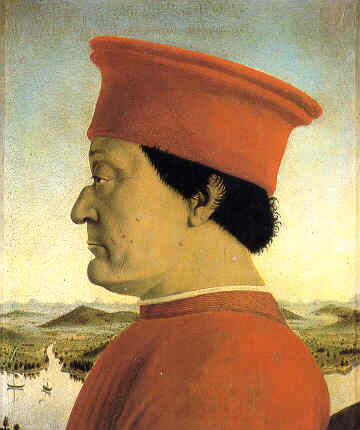
Hugh Trevor Roper’s chapter on the Venetian Doge, Francesco Foscari, and Dennis Mack Smith’s account of the life of one of the most under-appreciated Renaissance figures, Federico da Montefeltro, show a different aspect of the Renaissance period and underscore how interwoven and fluid the relationships were between the Papal States, Florence, Rome, Venice and Milan and increasingly also foreign powers.
Federico may have been Italy's most successful condottiero but once his fortune was made he also came to exemplify the classic Renaiassance man, embracing the arts as enthusiastically as he had for many years embraced war.
Various chapters in the book describe how the entrance of foreign armies into the Italian peninsular heralded the end of the high point of the Renaissance. In the space of little more than 30 years all of the major cities were affected in fundamental ways - Rome was sacked by unpaid German mercenaries in 1527, the siege of Florence two years later drained that city’s power and wealth and Milan lost its independence, never to be regained.
Only the Venetian Republic survived, and it would go on to survive for almost another three centuries until Napoleon put an end to a remarkable thousand years of unbroken self-governing independence.
Powerful and influential women figure prominently in the book, especially the two sisters Beatrice and Isabella d’Este, who have a chapter devoted solely to them, with others like Caterina Cornaro, Caterina Sforza and Lucrezia Borgia covered in a separate chapter titled ‘Women of the Renaissance’. Pope Pius II’s life is described by Iris Ortigo of ‘War in Val d’Orcia’ fame and the Machiavelli chapter is written by Garrett Mattingly, a Columbia University historian who also wrote the definitive description (in a book titled ‘The Armada’) of the defeat of the Spanish Armada in 1588. Written long ago in 1961, The Italian Renaissance is both well-written and easy to read.
Further reading: The Borgias by Christopher Hibbert
The Rise & Fall of the House of Medici by Christopher Hibbert


